
Garbage Collector
Java's Garbage Collector (GC) is a key feature of the Java Virtual Machine (JVM) that automatically manages memory. It helps developers by reclaiming memory occupied by objects that are no longer in use, preventing memory leaks and reducing the need for manual memory management. Understanding how the garbage collector works internally and its utilities can help developers write more efficient and optimized code.
What Is the Garbage Collector?
In Java, memory is divided into two main areas: the heap and the stack. The heap is where objects are stored, while the stack is used for method execution and local variables. Over time, as objects are created and discarded, the heap can become cluttered with unused objects. The garbage collector identifies and removes these unused objects, freeing up memory for new allocations.
Main Function of Java Garbage Collector
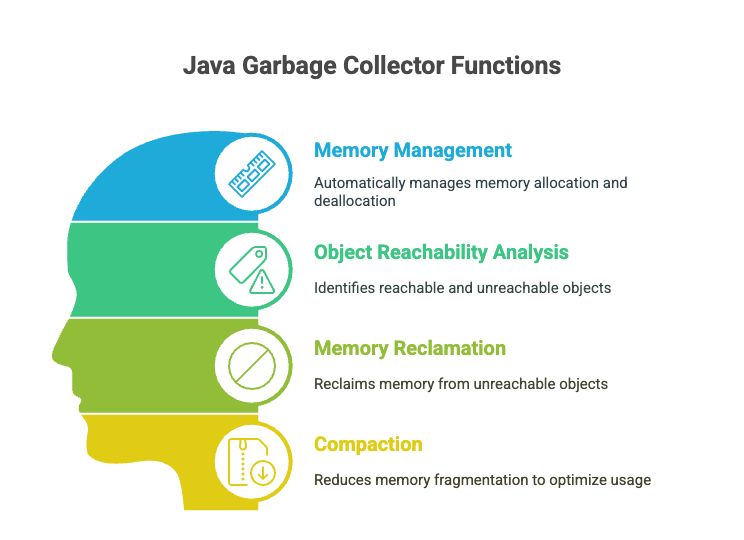
The primary function of the Java Garbage Collector is to identify and dispose of objects that are no longer reachable in the application, thereby freeing up memory resources. The GC operates in the background and performs the following key tasks:
- Memory Management: The GC automatically manages memory allocation and deallocation, reducing the risk of memory leaks and ensuring efficient use of memory.
- Object Reachability Analysis:The GC determines which objects are still reachable from the root references (like static fields, local variables, etc.) and marks those that are no longer reachable for garbage collection.
- Memory Reclamation : Once the unreachable objects are identified, the GC reclaims the memory occupied by these objects, making it available for future allocations.
- Compaction : In some GC implementations, memory compaction is performed to reduce fragmentation, which helps in optimizing memory usage and improving allocation speed.
How the Garbage Collector Works Internally?
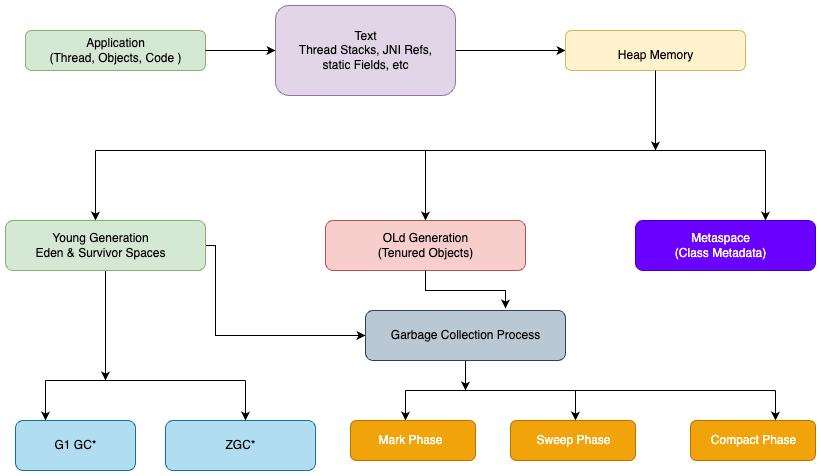
The garbage collector operates based on the concept of reachability. An object is considered "reachable" if it can be accessed directly or indirectly by a live thread. If an object is no longer reachable, it is considered garbage and eligible for collection. Here's a breakdown of how the garbage collector works internally:
Object Allocation:
- When a new object is created, it is allocated memory in the heap.
- The JVM keeps track of all objects and their references.
Mark-and-Sweep Algorithm:
The garbage collector uses the mark-and-sweep process to identify and remove unused objects.
- Mark Phase: The GC traverses the object graph starting from "root" references (e.g., static variables, local variables, and active threads) and marks all reachable objects.
- Sweep Phase: The GC scans the heap and removes objects that were not marked as reachable.
Generational Garbage Collection:
To optimize performance, the heap is divided into generations:
- Young Generation: Newly created objects are allocated here. Most objects are short-lived and are quickly garbage collected.
- Old Generation (Tenured): Objects that survive multiple garbage collection cycles in the young generation are promoted to the old generation.
- Permanent Generation (Metaspace in Java 8+): Stores metadata about classes and methods.
The GC focuses on the young generation more frequently since most objects die young, making the process faster.
Stop-the-World Events:
During garbage collection, the JVM may pause all application threads to perform the cleanup. These pauses are called stop-the-world events and can impact application performance if not managed properly.
Compacting:
After removing unused objects, the GC may compact the heap to reduce fragmentation and improve memory allocation efficiency.
Types of Garbage Collectors in Java
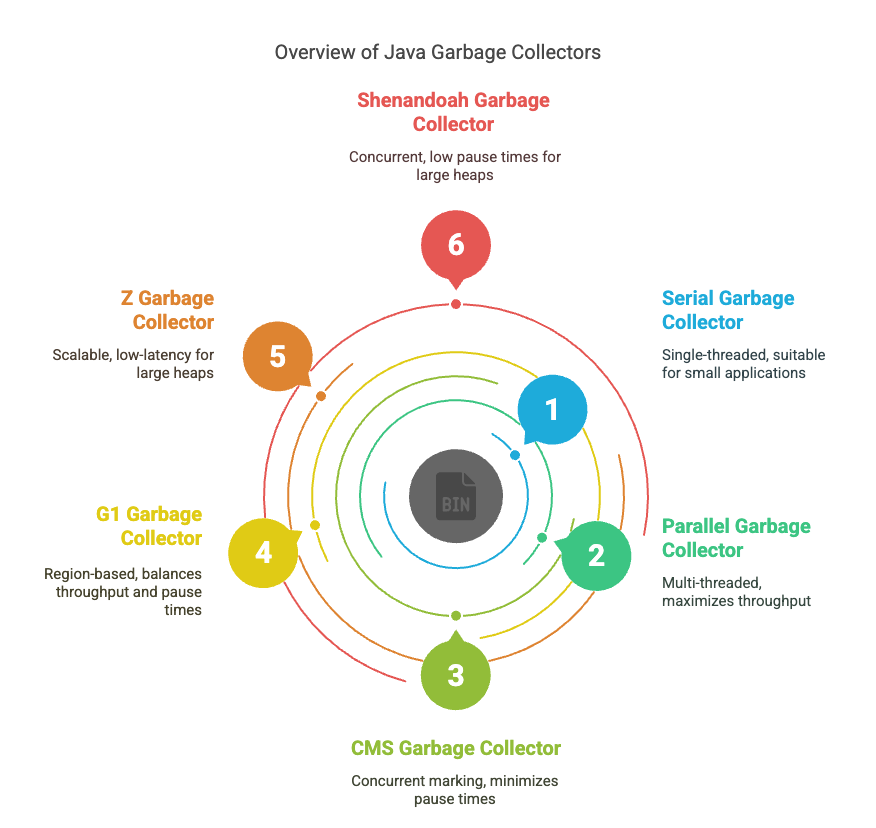
Java provides several garbage collection algorithms, each optimized for different use cases:
1. Serial Garbage Collector
The Serial Garbage Collector is the simplest type of garbage collector in Java. It uses a single thread for both minor and major garbage collection. This collector is suitable for small applications with a single thread or those running on a single CPU. Its main advantage is its low overhead, making it efficient for applications with small heaps.
Characteristics:
- Single-threaded.
- Suitable for small applications.
- Low overhead.
2. Parallel Garbage Collector
The Parallel Garbage Collector, also known as the throughput collector, is designed to take advantage of multiple processors. It performs minor garbage collection in parallel, which can significantly improve performance for applications with large heaps. This collector is ideal for applications that require high throughput and can afford to pause for garbage collection.
Characteristics:
- Multi-threaded for minor collections.
- Suitable for multi-core processors.
- Focuses on maximizing throughput.
3. Concurrent Mark-Sweep (CMS) Garbage Collector
The CMS Garbage Collector aims to minimize pause times by performing most of its work concurrently with the application threads. It uses multiple threads to mark and sweep objects, allowing for shorter garbage collection pauses. This collector is suitable for applications that require low latency and can tolerate some level of fragmentation.
Characteristics:
- Concurrent marking and sweeping.
- Low pause times.
- Suitable for applications with low latency requirements.
4. G1 (Garbage First) Garbage Collector
The G1 Garbage Collector is designed for applications with large heaps and aims to provide predictable pause times. It divides the heap into regions and prioritizes the collection of regions with the most garbage. G1 is particularly useful for applications that require a balance between throughput and low pause times.
Characteristics:
- Region-based heap management.
- Predictable pause times.
- Suitable for large heap applications.
5. Z Garbage Collector (ZGC)
ZGC is a scalable low-latency garbage collector introduced in Java 11. It is designed to handle large heaps (up to several terabytes) with minimal pause times, typically under 10 milliseconds. ZGC achieves this by using techniques such as colored pointers and concurrent marking.
Characteristics:
- Low-latency.
- Scalable for large heaps.
- Minimal pause times.
6. Shenandoah Garbage Collector
Shenandoah is another low-pause-time garbage collector that aims to reduce GC pause times by performing most of its work concurrently with the application threads. It is designed for applications that require low latency and is suitable for large heaps.
Characteristics:
- Concurrent garbage collection.
- Low pause times.
- Suitable for large heap applications.
Utilities of the Garbage Collector
Automatic Memory Management:
Developers don't need to manually allocate or deallocate memory, reducing the risk of memory leaks and dangling pointers.
Improved Application Stability:
By reclaiming unused memory, the GC ensures that the application doesn't run out of memory, improving stability.
Optimized Performance:
Generational garbage collection and compacting help optimize memory usage and reduce fragmentation.
Ease of Development:
Developers can focus on writing business logic without worrying about low-level memory management.
Monitoring and Tuning:
Java provides tools like JVisualVM, JConsole, and Garbage Collection Logs to monitor and tune garbage collection performance.
Best Practices for Working with the Garbage Collector
- Minimize Object Creation: Reuse objects where possible to reduce the load on the GC.
- Use Appropriate Data Structures: Choose efficient data structures to avoid unnecessary memory usage.
- Avoid Memory Leaks: Ensure that unused objects are not referenced, as this prevents the GC from reclaiming them.
- Tune the GC: Use JVM options (e.g.,
-XX:+UseG1GC,-Xms,-Xmx) to configure the garbage collector for your application's needs. - Monitor Performance: Regularly monitor GC logs and application performance to identify and address bottlenecks.
Newly Added Features in Java Garbage Collector
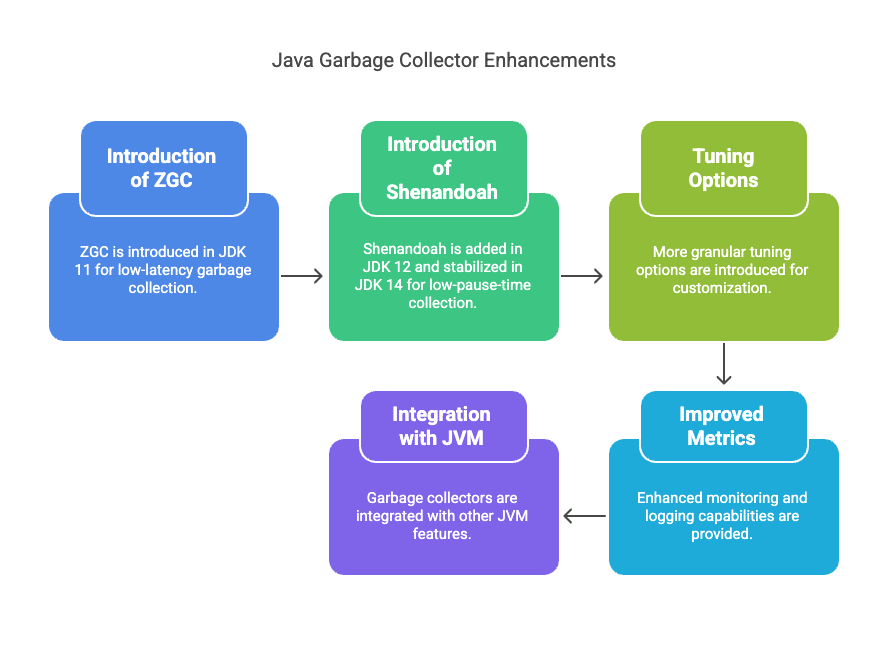
Recent versions of Java have introduced several enhancements to the Garbage Collector, aimed at improving performance and efficiency. Some of these features include:
- Z Garbage Collector (ZGC): Introduced in JDK 11, ZGC is a low-latency garbage collector designed to handle large heaps (up to multi-terabyte sizes) with minimal pause times. It employs a concurrent and parallel approach to garbage collection, allowing applications to run with minimal interruptions.
- Shenandoah Garbage Collector: Added in JDK 12 as an experimental feature and made stable in JDK 14, Shenandoah is another low-pause-time garbage collector. It focuses on reducing GC pause times by performing most of its work concurrently with the application threads.
- Garbage Collector Tuning Options: Recent Java versions have introduced more granular tuning options for garbage collectors, allowing developers to customize GC behavior based on application requirements. This includes options for adjusting heap sizes, setting pause time goals, and selecting different GC algorithms.
- Improved Performance Metrics: Newer versions of Java provide enhanced monitoring and logging capabilities for garbage collection events. This allows developers to gain better insights into GC performance and make informed decisions regarding tuning and optimization.
Integration with JVM Features: The garbage collectors have been integrated with other JVM features such as JEP 394 (Pattern Matching for instanceof) and JEP 411 (Deprecate the Security Manager for Removal), which enhance the overall performance and usability of the JVM.
Possible Interview Questions on Garbage Collector.
- What is garbage collection in Java, and why is it important?
- Explain the difference between the Serial, Parallel, CMS, and G1 garbage collectors. What are the advantages and disadvantages of each?
- How does the garbage collector determine which objects are eligible for collection? Explain the concept of reachability.
- What are the different types of references in Java (strong, soft, weak, and phantom), and how do they affect garbage collection?
- How can you monitor and tune garbage collection performance in Java? What tools and techniques can you use to identify and resolve garbage collection issues?